☸️ Kubernetes Architecture – A Beginner-Friendly Guide
👨💻 Last-year student diving deep into DevOps, Cloud Engineering, and Infrastructure Automation. Passionate about building scalable, efficient, and secure systems. Let’s connect and build something amazing! 🚀
📌 What is Kubernetes?
Kubernetes (K8s) is an open-source platform that automates the deployment, scaling, and management of containerized applications.
It helps developers and DevOps teams run applications efficiently across multiple environments on-premise or in the cloud.
🔹 Quick Facts about Kubernetes
✅ Developed by Google and later donated to the Cloud Native Computing Foundation (CNCF).
✅ Inspired by Google’s internal cluster management system, Borg.
✅ Why "K8s"? The 8 represents the number of letters between K and s in Kubernetes → K8s.
🎯 Why Use Kubernetes? (Key Benefits)
✅ Automated Scaling – Adjusts the number of running containers based on traffic.
✅ Self-Healing – Restarts failed containers, replaces them, and reschedules on healthy nodes.
✅ Load Balancing – Distributes traffic evenly across containers.
✅ Service Discovery – Helps services find and communicate with each other.
✅ Declarative Configuration – Uses YAML/JSON files to define infrastructure.
✅ Multi-Cloud Support – Works on AWS, Azure, GCP, or on-premises.
🏗 Kubernetes Architecture
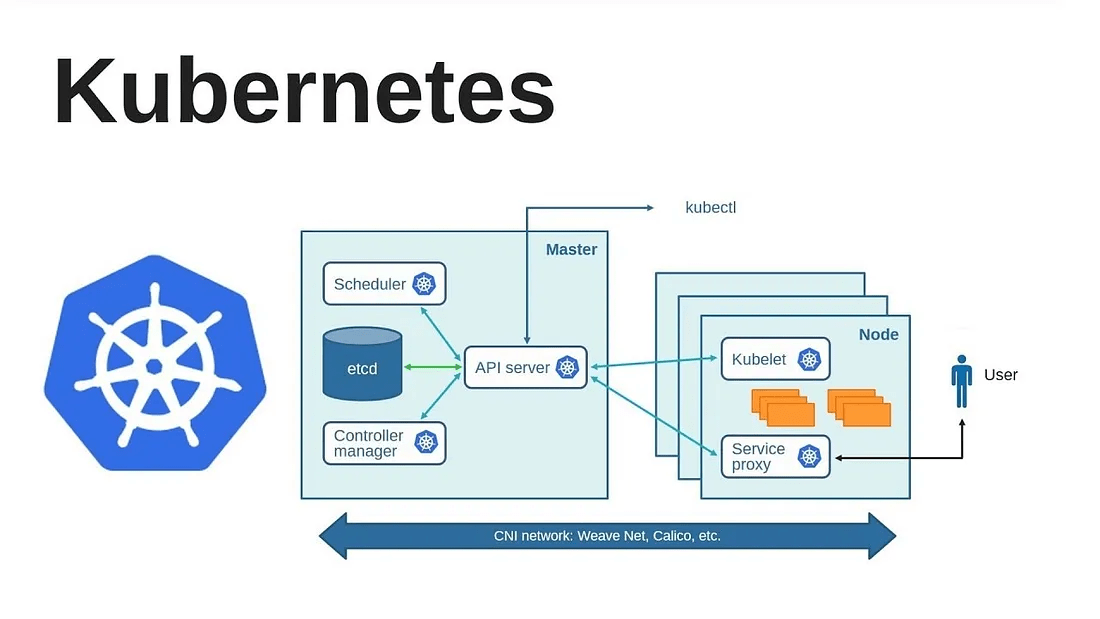
Kubernetes follows a Master-Worker Node Architecture, where the Control Plane(Master) manages the Worker Nodes.
📌 Main Components
1] Control Plane (Master Node) – The "Brain" of Kubernetes
Manages the overall cluster.
Ensures workloads run where needed.
Main Responsibilities
✅ Schedules workloads on worker nodes.
✅ Handles cluster-wide decisions.
✅ Manages communication between components.
2] Worker Nodes – The Machines Running Applications
- Handle the actual execution of applications.
3] kubectl – The Command-Line Tool
Used to interact with Kubernetes.
Sends instructions to the API Server.
🖥 Control Plane Components
Manages the entire cluster, ensuring apps run as expected.
🔹 API Server 🌐 – The entry point for all requests, like a city hall processing permits.
🔹 Scheduler 📝 – Assigns workloads (pods) to worker nodes, like a dispatcher.
🔹 Controller Manager ⚙️ – Watches over the cluster, fixing issues automatically.
🔹 etcd 🛢 – The memory, storing all cluster configurations.
🏗 Worker Nodes (The Workforce 💪)
These are the machines where actual applications run.
🔹 Kubelet 🔹 – Ensures containers run properly, like a site supervisor.
🔹 Kube Proxy 🔹 – Handles networking, ensuring smooth communication.
🔹 CNI 🌍 – Manages IP addresses and connections between pods.
🎮 kubectl (Command-Line Interface)
Installed on the user's machine.
Interacts with the API Server to manage Kubernetes clusters.
Common commands:
🔹kubectl apply– Deploy apps
🔹kubectl get pods– View running applications
🔹kubectl delete– Remove applications
🔄 Difference Between kubectl and kubelet
| Feature | kubectl 🖥 (Command Tool) | kubelet 🔗 (Worker Agent) |
| Definition | CLI tool to interact with the cluster. | An agent running on worker nodes. |
| Role | Sends commands to the API Server. | Ensures containers are running. |
| Location | Installed on a user's machine. | Runs on each worker node. |
| Usage | Used for deploying, inspecting, and managing apps. | Communicates with the Control Plane. |
🌐 The Role of the API Server
The API Server is the heart of Kubernetes. It serves as the main gateway for all communication inside the cluster.
📌 What Does the API Server Do?
✅ Accepts requests from kubectl, UI, or other tools.
✅ Validates and processes those requests.
✅ Stores cluster configurations in etcd.
✅ Acts as the single source of truth for the cluster.